

chapter 3: function slots
- FORM refers to the name of a thing (along with its definition)
- FUNCTION refers to how a thing is acting or operating in a particular context.
- nominal – a noun or any group of words that can substitute for a noun (word, phrase, or clause) and serve nominal functions. In other words, they can do anything that a noun can do, including filling any of the common nominal slots in a sentence (subject, direct object, subject complement, or object of the preposition most commonly).
- adjectival – an adjective or any group of words that can substitute for an adjective (word, phrase, or clause) and perform adjectival functions. In other words, they can do anything that an adjective can do (modify nouns or nominals most commonly).
- adverbial – an adverb or any group of words that can substitute for an adverb (word, phrase, or clause) and perform adverbial functions. In other words, they can do anything that an adverb can do.
- main verb phrase (verbal) – the main verb of a clause plus its auxiliary or helping verbs in an unchanging order.
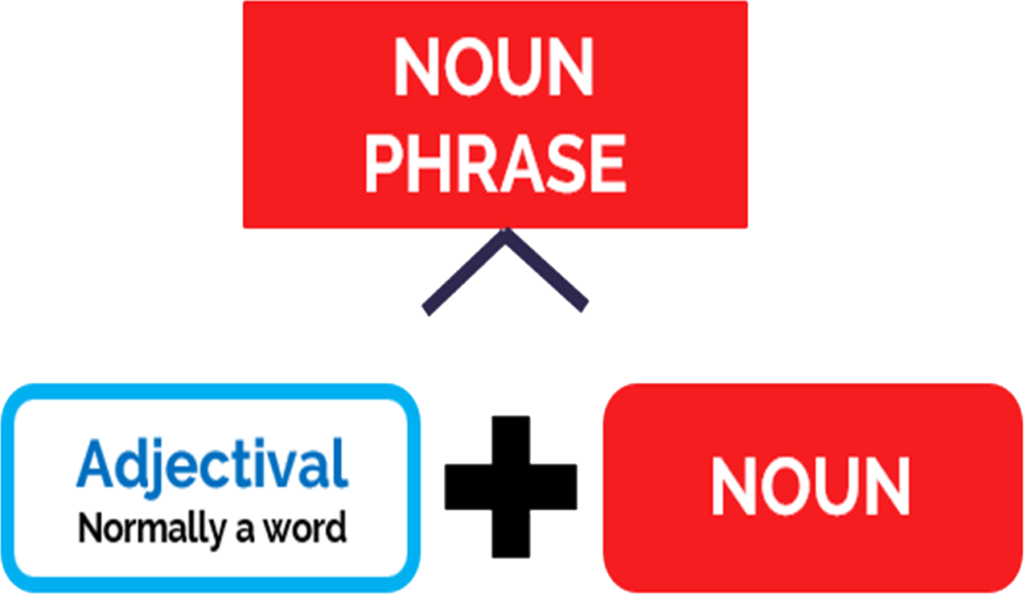
This means that an adjectival can appear before and modify a noun. But another noun can fit into the adjectival function slot, such as the noun phrase BASEBALL BAT. If we analyze at the word level, the form of BASEBALL is a noun, but in this noun phrase its function is adjectival to modify BAT.
But there are other nominal FUNCTION SLOTS that we may need to account for in analyzing our language, and these also appear in consistent places:


In many cases, the nominal appositive will take the form of a NOMINAL THAT-CLAUSE. And like these nominal function slots, an adjectival modifier will normally appear in specific places. In other words, since an adjectival modifies a nominal, it will normally appear either directly preceding or directly following the nominal that it is modifying. When analyzing for adjectivals, be careful not to stray too far from identifying the nominal that it is modifying. If you have to stray too far away, then what you are trying to identify might not be an adjectival.
When analyzing for nominals or adjectivals, the most effective test is the “substitution” test. If you can replace the questionable phrase (or clause) with the word “SOMETHING,“ you can normally argue that it is functioning nominally. It’s not quite as accurate for adjectivals, but you can try substituting the questionable phrase (or clause) with a single prototypical adjective. If you can do this, then you can assume that it is occupying an adjectival FUNCTION SLOT.
Finally, adverbial modifiers are almost always optional and can show up (or not) just about anywhere, although their FUNCTION SLOTS will appear most often at the beginning or the end of a clause or sentence. The two best tests for adverbials are DELETION and/or MOVEMENT. In other words, if you can delete the questionable phrase (or clause) and the clause or sentence still makes sense and retains the same basic meaning, then it is probably an adverbial. Likewise, if you can move the questionable phrase (or clause) to different parts of the clause/sentence it is in and the clause/sentence still makes sense, and retains the same basic meaning, then it is probably an adverbial.
In most cases, function slots will appear in consistent places in and around clauses (nominal slot – subject + MVP slot – main verb phrase). The simple graphic below represents ways that different FUNCTION SLOTS might fit together. Finally, the most important thing to remember is that a NOMINAL slot, an ADJECTIVAL slot, and an ADVERBIAL slot can each be filled by a word, a phrase, or a clause. The MVP slot can only be filled by a Main Verb Phrase.

We will explore examples for how this occurs in much more detail throughout the rest of this book.